How to know which path fits your process, your team, and your long-term business goals.
When contractors compare custom software vs off-the-shelf software, the most important question is not which option has more features. It is which option fits the workflow your office and field teams use every day.
In simple terms, off-the-shelf software gives businesses a predefined set of features and workflows. Custom business workflow software is built around the specific steps, roles, approvals, and information your company needs.
The five factors are workflow fit, team adoption, approvals and handoffs, data and integrations, and cost and long-term flexibility.
When Is Off-the-Shelf Software the Right Choice for Contractors?
Off-the-shelf tools are a strong match when your workflow is:
- Simple
- Predictable
- Unlikely to change
- Able to adapt to the software’s existing workflow
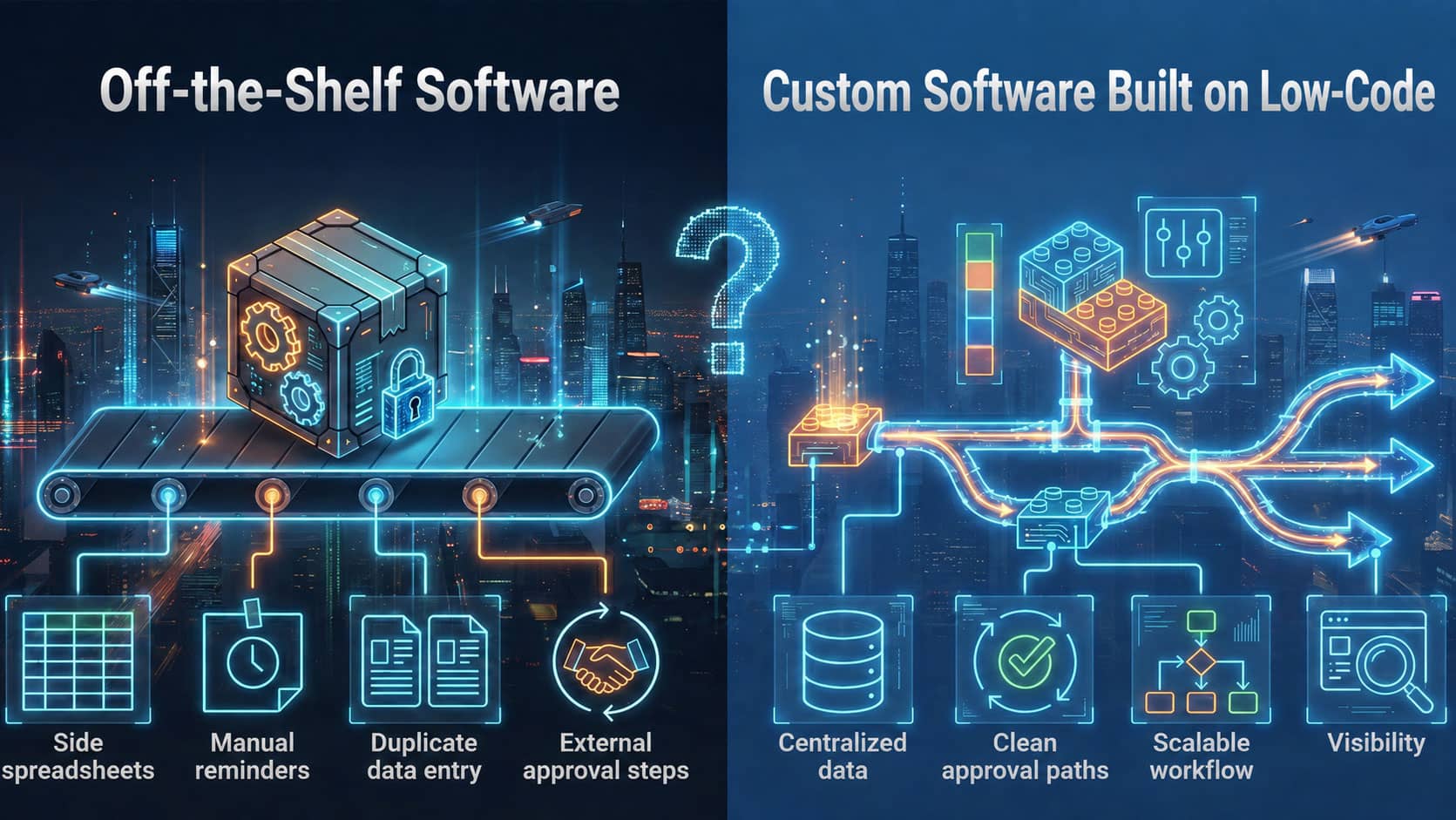
You get a fast setup, a fixed feature set, and minimal maintenance. Problems show up when your real process doesn’t match how the tool expects you to work.
That’s when you start seeing:
- Side spreadsheets
- Manual reminders
- Duplicate entry
- Approval steps happening outside your system
Every workaround slows decisions and increases the chance for costly errors.
For a contractor, that can mean project information living in one system while estimates, approvals, field updates, change orders, or job costs are tracked somewhere else. The software may still work, but the workflow around it becomes increasingly manual.
When Does Custom Low-Code Software Make More Sense for Contractors?
Custom software built on a low-code foundation changes the approach. It starts with an established technical base. The workflow can then be built around your company’s steps, roles, and data.
Custom low-code software can give contractors:
- Centralized, accurate data
- Clean approval paths
- Less duplicate entry and fewer side spreadsheets
- Visibility for managers and clarity for teams
- Connections between the tools and information your team already uses
Custom low-code software can make more sense when your process is evolving, accuracy is critical, or decisions depend on current information from multiple parts of the business.
The key difference is workflow fit. Instead of changing your process to match a predefined system, the workflow can be designed around how information actually needs to move through your business.
If your needs are basic and stable, off-the-shelf may be all you need. If your operation depends on specific handoffs, approvals, integrations, or information moving between the field and office, custom business workflow software may be a better fit.
Custom Software vs Off-the-Shelf Software: The Real Difference
| Question | Off-the-Shelf | Custom Software Built on Low-Code |
| Who adapts? | Your workflow typically adapts to the software | The system is built around your workflow |
| Best fit | Standardized, predictable processes | Specific or evolving workflows |
| Complex approvals? | Depends on available features and configuration | Can be designed around required approvals and handoffs |
| Integrations | Depends on the integrations the product supports | Can connect the apps and information used in your workflow in many cases |
| Speed to launch | Typically faster to start | Depends on the scope and requirements of the build |
How Should Contractors Choose Between Custom and Off-the-Shelf Software?
When comparing custom software vs off-the-shelf software, consider these five factors:
- Workflow fit: Does the software support how your team works, or will your process need to change?
- Team adoption: Can employees easily find information and complete their next step?
- Approvals and handoffs: Can the system manage your required reviews, responsibilities, and status changes?
- Data and integrations: Can it connect the tools and information your company already uses?
- Cost and long-term flexibility: Consider setup, maintenance, workarounds, and future changes.
A useful way to evaluate your current software is to look at what your team has to do outside of it.
If employees regularly need spreadsheets, texts, emails, paper forms, or duplicate data entry to complete a process, those workarounds may indicate that the software does not fully support the workflow.
For contractors, this becomes especially important when project information needs to move between estimating, the office, the field, approvals, change orders, job costing, and billing.
Choose off-the-shelf software when your process is simple and unlikely to change.
Choose custom software built on a low-code foundation when your workflow requires specific handoffs, approvals, integrations, or frequent updates.
The right choice is not automatically custom software. It is the option that lets your team complete the workflow with the least unnecessary manual work while giving decision-makers the information they need.
Where DTIC Fits In
At DTIC, we build custom business workflow software on a low-code foundation.
We replace inconsistent spreadsheets and patchwork systems with integrated workflows that put your data in one place for your team and your leaders.
If you’re evaluating your options, a discovery call is where we walk through your challenges, goals, and workflows. Our goal is simple: build a system that works the way your people actually work.
Your construction workflow should work for you, not the other way around.
If you want to determine whether off-the-shelf software or a custom low-code workflow is the better fit for your business, schedule a discovery call.